
Forget Salads and Smoothies—These 2 S’s Matter More

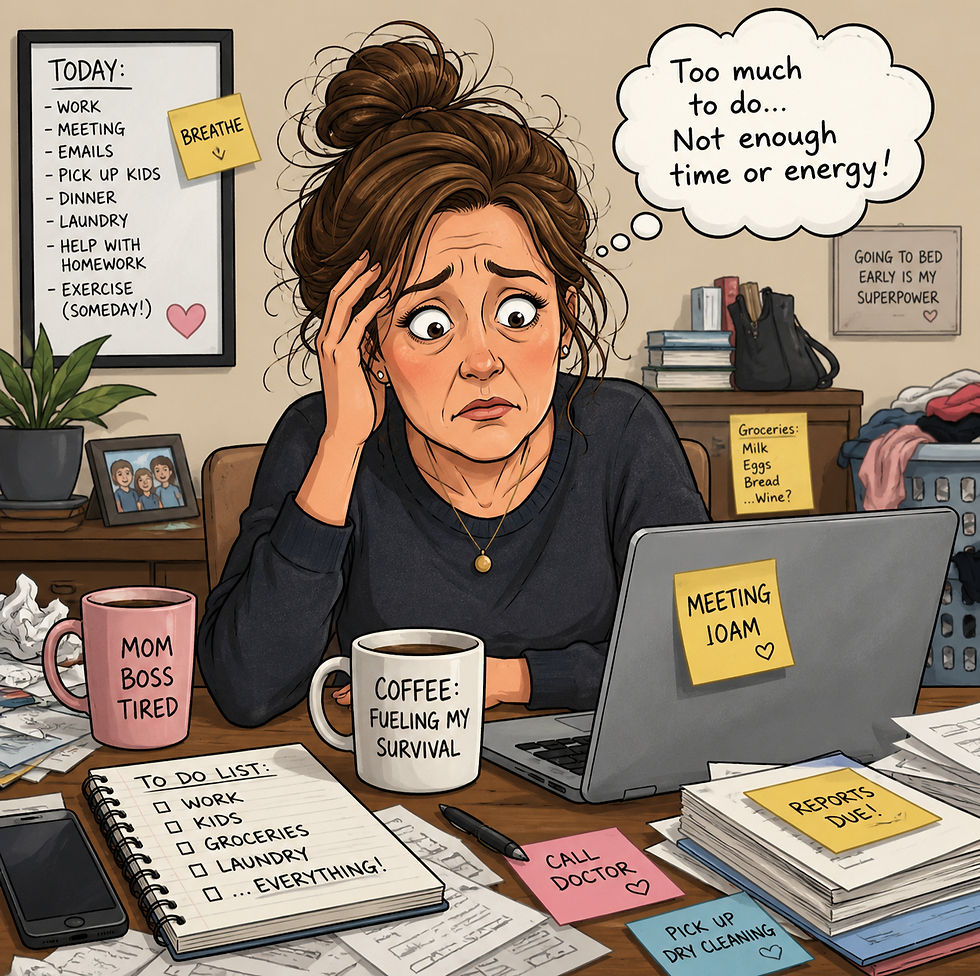
When most people think about weight gain or difficulty losing weight, they immediately focus on food.
Calories.
Carbs.
Sugar.
Willpower.'
But in my experience, two of the most overlooked factors affecting weight are stress and sleep. Trying to lose weight while chronically stressed and underslept can feel like swimming upstream. Today I want to focus on stress—because I’d go as far as saying stress management is one of the most overlooked pieces of long-term weight management.
Stress Isn’t Just Emotional
Most people think stress is just a feeling.
But stress is physiological too.
Your body doesn’t necessarily distinguish between:
work stress
financial stress
relationship stress
lack of sleep
overtraining
chronic dieting
inflammation
hormonal changes
or constantly feeling overwhelmed and overstimulated
To the body, stress is stress.
And when the body perceives stress, it shifts into a more protective, survival-oriented state.
That’s incredibly helpful short term, but when stress becomes chronic, the body starts adapting to survive—not thrive. And that affects weight in a lot of ways.
Stress Changes the Way the Body Functions
Chronic stress can:
increase cravings
affect hunger and fullness hormones
increase emotional eating
worsen blood sugar regulation
disrupt digestion
increase inflammation
worsen sleep
reduce motivation and energy
and contribute to increased abdominal fat storage
Sometimes the effects are subtle and not everyone stress eats.
Some people stop eating during stress and then overeat later .Others become too exhausted to exercise consistently. Some feel inflamed, puffy, or “stuck” no matter how hard they try.
I think this is one reason people become so frustrated with weight loss.
They assume it’s simply a discipline problem.
Meanwhile the body is functioning in a chronically stressed state.
Undereating Is Also a Stressor
This is another piece that gets overlooked—especially with extreme dieting or GLP-1 medications.
When the body consistently perceives that energy intake is too low, it interprets that as a potential threat to survival. In other words, the body thinks: “Resources are scarce.”
And that perception alone can increase physiological stress.
This is one reason it’s so important to properly support the body while using GLP-1 medications or any type of “dieting”.
Because eating significantly less without paying attention to:
protein
muscle maintenance
nutrient intake
digestion
and overall metabolic health
can eventually start working against the body instead of with it.
One of the ways the body adapts to prolonged undereating is by conserving energy.
Metabolism slows down. Energy drops. Recovery worsens. Movement often decreases naturally. The body becomes more efficient at surviving on less, which makes perfect sense from a survival standpoint. But it becomes frustrating for people who feel like they’re “doing everything right” while still struggling with fatigue, body composition changes, or weight plateaus.
The Nervous System Matters More Than Most People Realize
I’ve been reading “Why Zebras Don’t Get Ulcers” by Robert Sapolsky and the title alone hooked me. One of the most fascinating ideas in the book is that animals experience stress too—but they move through it differently than humans do.
A zebra being chased by a lion experiences a massive stress response, similar to what we experience when stressed:
adrenaline
cortisol
increased heart rate
heightened alertness
But once the threat is over, the zebra doesn’t go sit around replaying the experience, worrying about tomorrow’s lion encounter, doom scrolling social media, answering emails, or mentally catastrophizing the future.
It physically releases the stress response and then goes back to grazing, but humans don’t do that very well.
We suppress stress. Ignore it. Push through it. Replay conversations. Worry about the future. Stay overstimulated.
And the body often continues responding as if the threat is still happening.
That has real physiological consequences over time.
Women in Midlife Feel This Even More
This becomes even more important during perimenopause and menopause because estrogen plays a much bigger role than most women realize.
It affects:
mood
sleep
nervous system regulation
insulin sensitivity
appetite signaling
body fat distribution
and overall stress resilience
As estrogen declines, many women notice they suddenly feel:
more anxious
more reactive to stress
more exhausted
more overstimulated
or simply less resilient than they used to feel
At the same time, sleep often worsens too. And when estrogen depletion and chronic stress start happening together, it creates a perfect storm physiologically.
Cortisol rises. Recovery worsens. Blood sugar regulation becomes more difficult. Abdominal weight gain becomes more common. Cravings increase. Energy drops.
And many women blame themselves.
“I must be doing something wrong.”
When in reality, the body is navigating a major hormonal transition while often already carrying years of accumulated stress and under-recovery.
This Is Why Weight Loss Isn’t Just About Willpower
I think many people are trying to “diet” their way out of a chronically stressed and exhausted nervous system, and that’s why the process often feels so hard.
Weight management is about far more than food.
The nervous system matters. Stress matters. Sleep matters .Recovery matters. Hormones matter.
And when those things are ignored, the body eventually lets us know.
What Actually Helps
For me personally, learning how to better support and regulate my nervous system has become foundational. Not perfection or eliminating stress completely, because that is impossible.
But learning how to help my body feel safer and more resilient while moving through life.
Things like:
walking
strength training
prayer and meditation
being outside
quiet time
deep breathing
reducing overstimulation
connection with people I trust
and creating boundaries around constant input and technology
One thing I use daily is tapping, also known as EFT (Emotional Freedom Technique).
I know it sounds a little weird if you’ve never tried it, but I’ve found it incredibly effective for calming my nervous system and interrupting that constant “fight or flight” feeling that so many of us live in without even realizing it.
Instead of just mentally pushing through stress, tapping gives the body a way to physically and emotionally downshift. And honestly, I’ve found nervous system modulation to be one of the most overlooked pieces of sustainable health and weight management.
These things sound simple
.
But physiologically, they matter far more than most people realize.
Because sustainable health isn’t just about controlling calories.
It’s about supporting the body as a whole.
Next Up
And stress is only half the equation.
The other major piece?
Sleep.
Because sleep deprivation affects hunger hormones, cravings, blood sugar regulation, recovery, decision-making, and metabolism more than most people realize.
I’ll break that down in the next post.
Use the Contact Form at the bottom of this page to Book Your Free Discovery Call!